


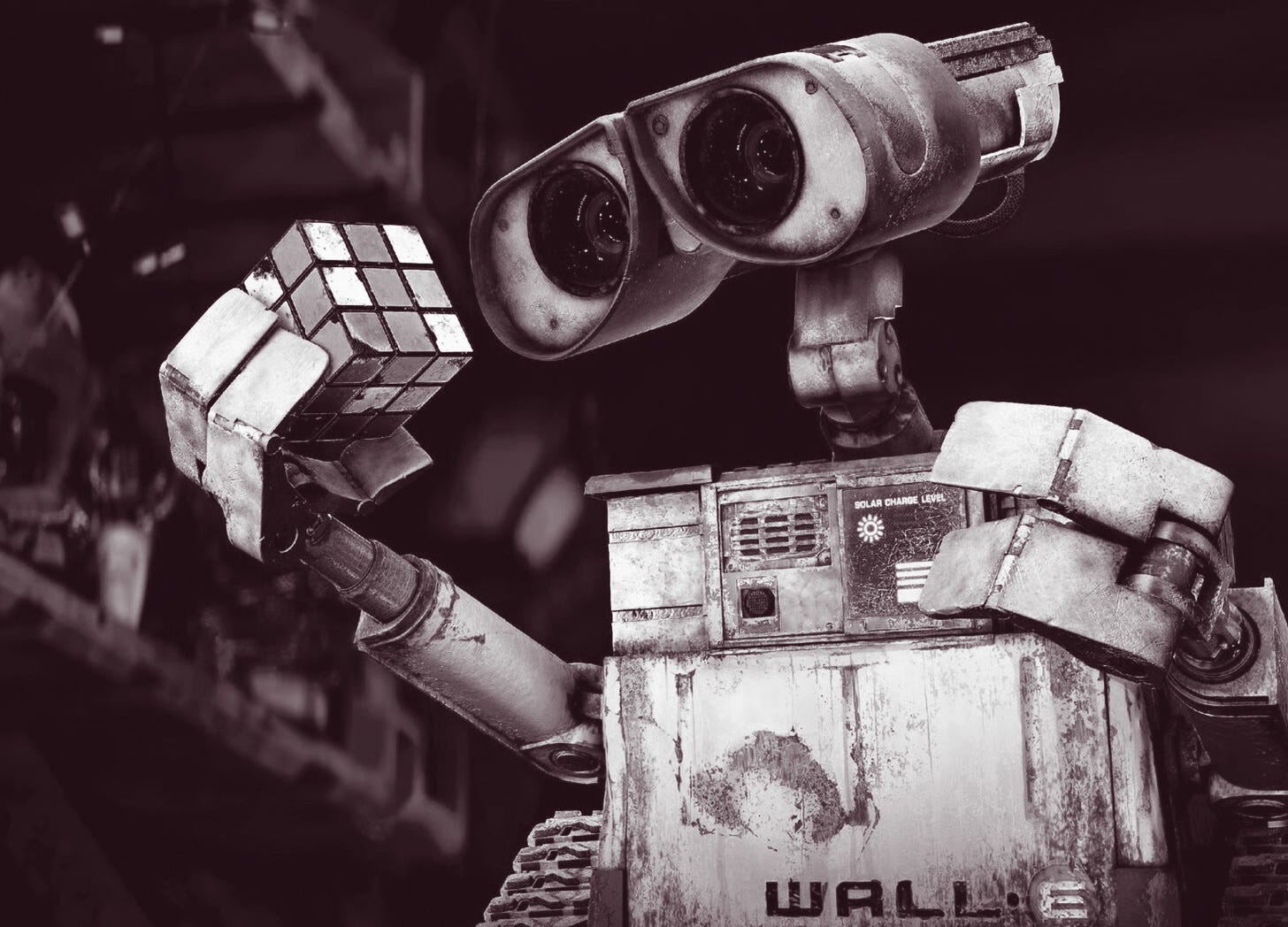
WALL·E seals the heavy metal door just as the sandstorm breaks. Outside, the wind scours the earth with grit and noise. Inside, the light softens. He settles in front of the small glowing screen and presses play. A song begins. For a few minutes, the world narrows to movement, gesture, and the promise of hands reaching for one another.
Before this solace, we witness the labor that makes WALL·E’s treasured reprieve possible, the millennium of heaped trash, the long burnt orange days resolving to oil green shadows: sunset as expiration date. The haze drifting through the frame recalls the smoke that filled New York last year, when distant wildfires turned daylight into eerie Martian skies.
Longevity is inseparable from isolation
Waste Allocation Load Lifter: Earth-Class. A construction worker, a maintenance robot, alone for hundreds of years, cheerfully and sturdily keeping faith with a humanity that long ago set him his industrial purpose. I thought of WALL·E again while writing Throwing Voices. Pixar’s assemblage/hero scavenges replacement eyes, second-hand treads, viable upgrades of his worn parts. WALL·E is a koan and a coda, as much a long-tail patch as Del Toro’s Creature.
Inside his garage, WALL·E unpacks what he has gathered: the useful, the unusual, the things that delight him—spare parts, a spork, a lighter. He places a find (another rubber duck!) in its bin, with the collector’s satisfaction of making a quality addition to the set. Still, there is longing. He bangs the dirt from his lunchbox and looks up at the stars. Despite the gulf of time between them, he wants what so many before him have wanted: a companion. Someone like him.
Sanctuary fantasies
Shelter has its own grammar. The sounds that lull us to sleep aren’t usually of weather in the open. Often, they are rain striking a roof, snow brushing a tent, the reassurance that something stands between us and what rages outside. Filmmakers have always understood this. Again and again, cinema returns to rooms that offer pause—places where characters hide long enough to gather themselves, to think, to survive.
That instinct is what led me from WALL·E to Scorsese’s Hugo. Hugo lives inside a machine, slipping through the vast gears of the Gare Montparnasse. His small body moves against enormous mechanisms, dwarfed by scale in the same way WALL·E is dwarfed by towers of waste. Refuge arrives at last, when Hugo pulls the workshop lever to a locked position, sealing himself into a sanctuary of notebooks and tools. That heavy metal door between himself and all circumstances daunting and precarious made me feel the bond between WALL·E and Hugo.
It may not seem like much to anybody else, but to Hugo, his notebooks and gears are no less sweet than WALL·E’s sprockets and tins. WALL·E rewinds a videocassette, a relic of a vanished home-life ritual. Hugo oils the joints of an automaton built in the early days of cinema. Careful hands ease something from stiffness. An image appears. In each case, motion carries time forward, allowing the past to speak again—not as history, but as presence.
‘Tis the season
To love these films is really to love the idea of moviegoing itself: the darkened room, the light held in place long enough to mean something, the permission to rest momentarily while the world continues outside. WALL·E and Hugo both leave their fortresses, seeking connection. They step back into danger because meaning requires exposure. But the memory of shelter travels with them. It’s a fitting fable for the dead of winter, for these long solstice nights.
I find myself drawn, especially now, to that permission. No milk or sugar with that pause, thank you. But yes, for a moment, an inner sanctum. Less octane, more recharge. Winter invites a slower rhythm, a deliberate narrowing of focus. The solstice brings with it the pleasure of crossing a threshold and closing the door of the year.
In the season of renewal, like WALL·E, I give myself over to beams of light in the dark.
Cinema has always offered that kind of refuge: a temporary room built of light and shadow, where responsibility can be set down without being abandoned. The night will still be long tomorrow.
Thanks for reading! The Pounce returns in January 2026 with Series 2. Happy Holidays!