


After I finished writing last week’s column, I found myself still thinking about Arnold Schwarzenegger. In order to create a “compelling routine,” he gave real attention to the spaces between poses, the part lesser performers don’t see as a wealth of potential. Schwarzenegger studied every detail.
“To hypnotize and carry away an audience, you need the poses to flow. What do you do between one pose and the next? How do the hands move? How does the face look?”
He encountered a sublime, personal choreography. In his memoir, he wrote that he discovered he could, “ride the melody like a wave--quiet moments for a concentrated, beautiful three-quarter back pose, flowing into a side chest pose as the music rose and then wham! a stunning muscular pose at the crescendo.”
Serpentine
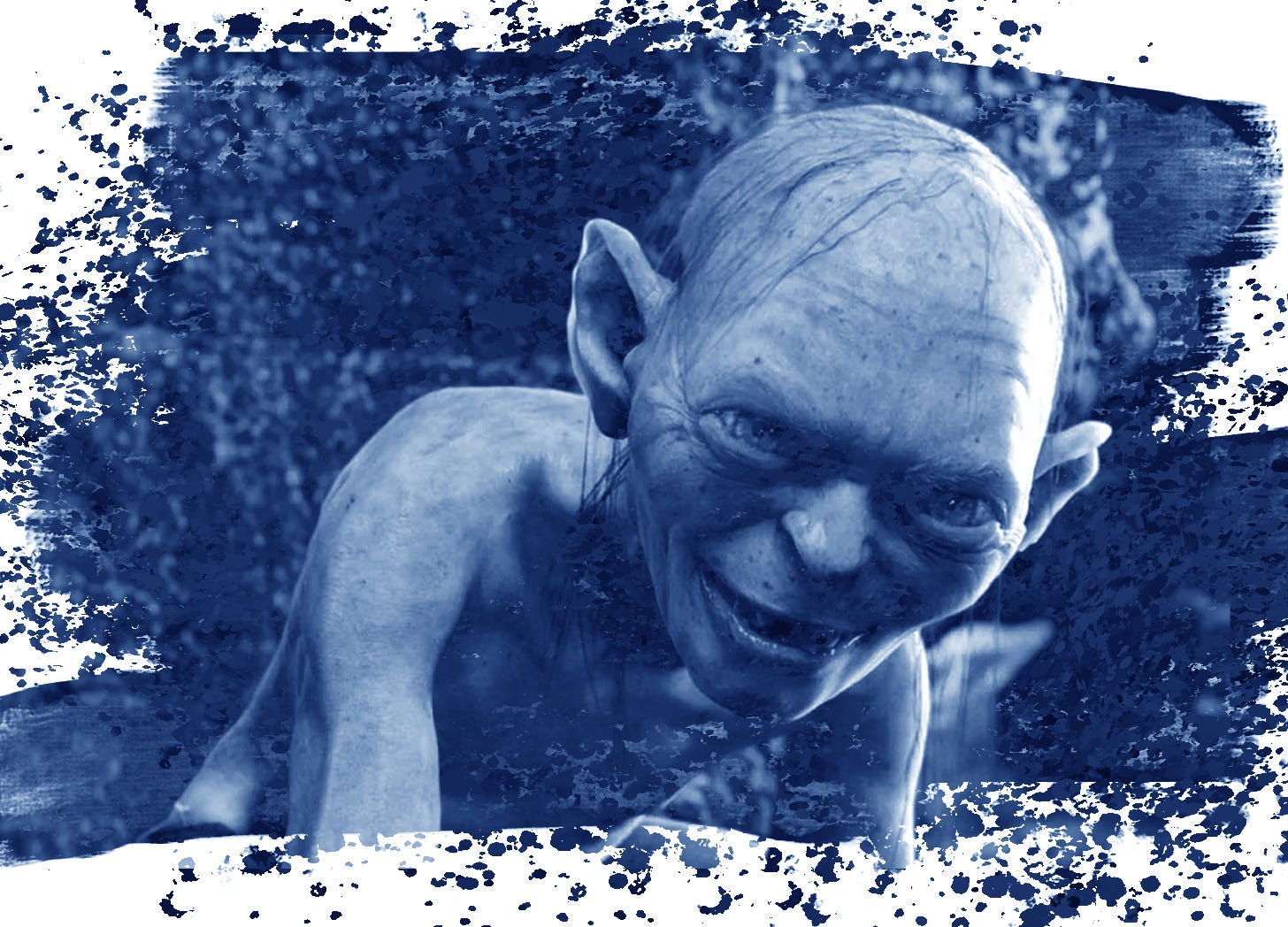
It was the way he fully inhabited his craft that brought me back to Andy Serkis. In my research I kept returning to a behind-the-scenes photograph: his face covered in a field of tiny motion-capture markers, already half-transmuted into Gollum.
Originally, Wētā had mapped the sensors onto a pre-designed Gollum model — essentially an animated wireframe wearing borrowed expressions downloaded from Serkis. But then they had a small epiphany: what if the character’s face matched the actor’s?
Once they redrew the facial structure to echo Serkis’s own musculature, something unlocked. Serkis wasn’t merely guiding Gollum; he was inside him. With a few analog pencil strokes the animators brought the living face across the digital divide.
That small invention, a performer enlarging the form from within, reminded me of another figure who endowed inanimate material with life: Loïe Fuller.
Silk screen
In 1892 Fuller transformed a vaudeville genre called skirt dancing, a hybrid of ballet and dance-hall clogging. The Times described it as half “the Court” and half “the gutter”. (Skirt dancing also gave rise to the French cancan: an art of movement built from fabric, legs, and velocity!)
Fuller reimagined the vaudeville entirely. She engineered extension poles into her costume and patented them as “a mechanism for the production of stage effects.” With these hidden wings she lifted and swirled billowing volumes of silk into spirals of color and light. A New York review extolled the performance as “unique, ethereal, delicious.” As she moved further from burlesque toward something visionary, she slipped out of the dance hall’s orbit altogether. Audiences came to see her not as an novelty act, but as a legitimate artist.
To the Symbolist artists watching her in Paris, she seemed to dissolve solid form into continuous metamorphosis. They saw her spirals of silk as currents of light and dream, and critically embraced a performance of transformation they recognized as creativity itself.
Loïe Fuller made performance look like art; Jean Renoir made art look like performance. Renoir felt something similar in his bones. In French Cancan, he filmed entirely on sets to highlight the world as performance. Director Peter Bogdanovich once said it “walks an extraordinary line between artificiality and reality.” Fuller expanded the possibilities of fabric and light; Renoir expanded the possibilities of cinematic artifice.
Standing in a theater watching Jurassic Park Peter Jackson saw digital creatures step across a threshold. He understood that animation was no longer a trick layered on top of a performance, but a space where performance itself could live. In that moment, he expanded the expressive room of visual effects the same way Fuller expanded the stage and Renoir expanded the set: sensing that the form had more life in it than anyone realized, they gave it room to grow.
And the impulse recurs
Echoing Loïe Fuller, Frank Zane once told the Times that bodybuilding was “the creation of living sculpture…a performing art,” and said he wished posing routines had lighting and music integrated like theater. Schwarzenegger, of course, felt the same instinct: the routine was not a sequence of poses but a continuous, expressive form.
Audiences have often responded to this kind of expansion. When the Whitney organized Articulate Muscle: The Male Body in Art, they expected a hundred people to attend. Thousands arrived instead — booing the art experts, cheering the bodybuilders rotating on a platform beneath the museum lights. Andy Warhol was there. Candice Bergen was there. Everyone understood, viscerally, what the panel was trying to aestheticize. The form had already outgrown their frame.
Jackson also had his own version of this expansion. When he saw the T-Rex in Jurassic Park, he felt immediately that the medium had shifted. The tools could now carry the weight and coherence of real performance. And once he sensed that, he didn’t treat digital effects as decoration; he embedded them as the nervous system of how the story could move. Which is why Serkis’s audition landed the way it did. Jackson had already recognized that the space for acting had widened.
Jackson tells the story: when Serkis arrived to audition, he “jumped on the furniture… leapt on the chairs… went on the floor,” mimicking his cat coughing up a hairball, sending papers flying. He didn’t just offer a voice; he offered a performance so vivid it forced the technology to evolve around him.
Like the tail of a kite
That’s the thread dancing through all of this — Fuller, Serkis, Schwarzenegger, Renoir. They didn’t abandon the constraints of their forms; they transformed the constraints into stage directions. They expanded the life of the form from the inside until something new appeared.
The way I think of it, form is shifting before we are. Form is vital not static. Artists like Fuller or Serkis or Renoir or Jackson aren’t pushing anything so much as listening, answering something moving inside themselves in response to the medium. Forms are more flexible than we are: we get attached to our ideas. We think we’re geniuses but we’re nostalgic, like Bilbo standing in his living room.
In our fairy tales, in our centuries-old myths of self creation, the protagonist senses the new world, is off and running, finding form in motion, leaning into the change. Loïe Fuller’s influence went places even she couldn’t have predicted — into painters, poets, filmmakers, anyone drawn to the expressive possibilities of metamorphosis.
Maybe that’s why artists are essential: they spark in the friendly gloom of the familiar something dangerously new and alive.