


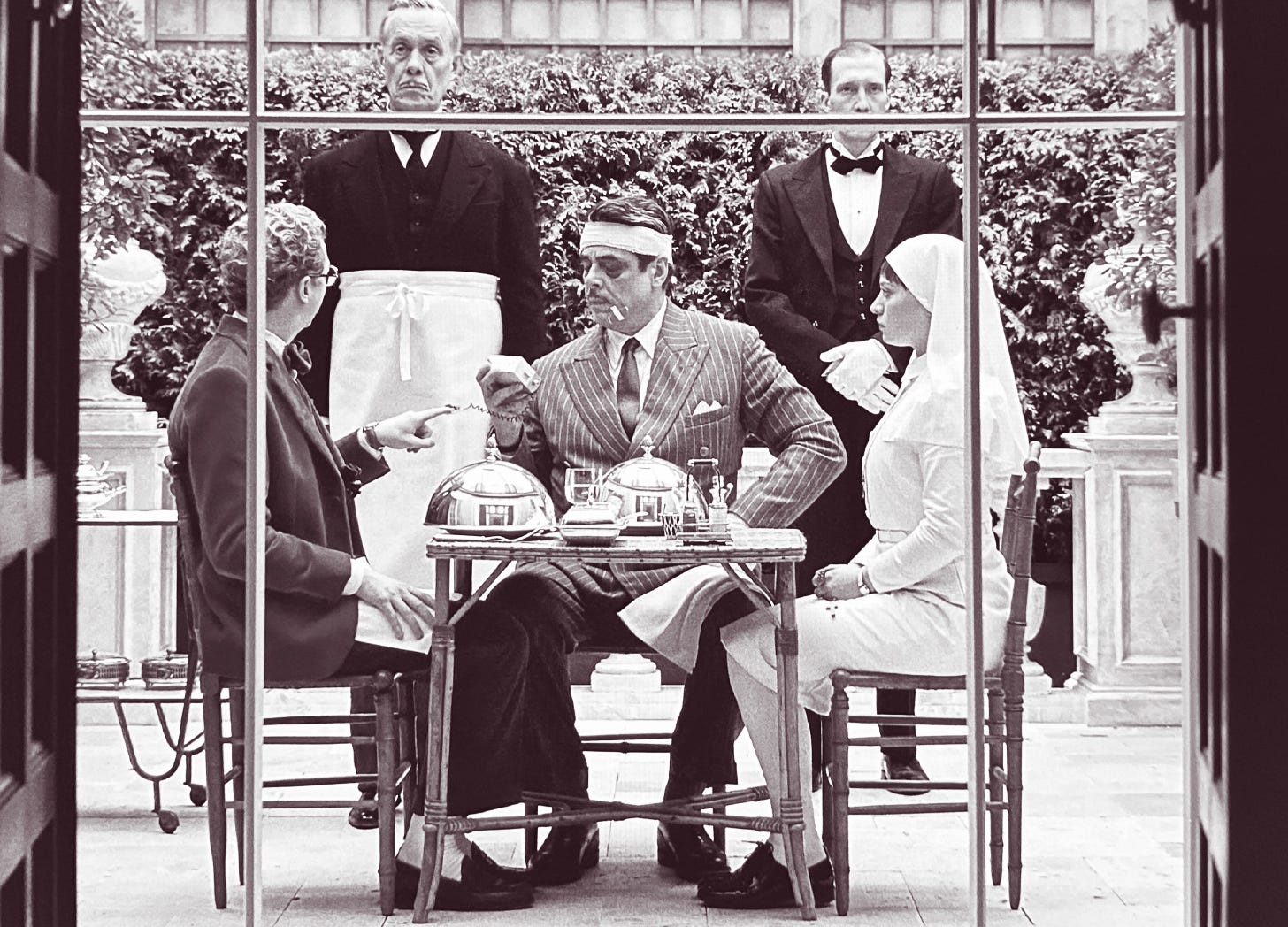
Appetizers circle. “Lamb cigar?” The husband of the rising star soprano indulges. He’s an interesting person, you know, he’s married to her, not her career. My eyes send a gentle pulse toward the eyes-in-the-back-of-his-head wine captain. In the beat of an hors d’oeuvre, a tray of champagne surfaces from the raconteurs and perfume of the crowded room. The opera husband notices laughter, clocks who it is, who they are looking at. I hand him a glass as I take mine from the tray. “You were saying?”
Conversation, calculation, vaudeville, and violence. This is why I enjoyed watching The Phoenician Scheme. The elusive subject and the consequential verbs finally pull the pin on that repeated offer to “Help yourself a hand grenade.” Proper form is the mother of screwball.
First, the flowchart shoeboxes of the Korda Land and Sea Phoenician Infrastructure Scheme, then perfectly roasted pigeons served on the terrace. Poisoned wine and the lie detector float on the crisp white linen, but under the table, attractions and cross purposes are laid out in bamboo.
Escape velocity
There are stories that draw the audience by means of complication, i.e. the well known reversals that turn up suspense and confound expectations. Complicated things operate by rules, and when the rules are broken? Voila, we have a change of fortune. However, and much to my delight, The Phoenician Scheme is not that kind of story.
Rather, we have complexity, interactions that result in emergent, unpredictable behaviors. In The Phoenician Scheme, the situation of these interactions is known as The Gap.
The Gap, at speed, is chaos.
Though their mechanisms are disparate, I might say speed was the reason The Phoenician Scheme kept reminding me of George Cukor’s The Women. “Watercress. I’d just as soon eat my way across a front lawn.” Help yourself, indeed.
The two movies gain their momentum into plot by the stage business of gossip and contracts. They make ideal cocktail party companions, riffing off each other in complimentary registers. But it’s the accumulating patter, it’s the report and ricochet that keep me rapt, and signaling for another champagne.
Overlapping lines
Why did they talk so fast in those 30s films? After all, in spite of a propensity for Benzedrine inhalers, people a hundred years ago didn’t talk faster than we do.
When movies learned to talk, they didn’t know how to convey plot through dialogue. So they invented, and they accelerated. Anita Loos rewrote The Women to get past the Hays Code, then kept rewriting it live in real time from a chair on the set, tossing ad-libs to the actors while the camera rolled.
Abstemious people set their course through a cocktail parties by marking a set of rules. There’s a price to pay if you break them, and a margin of safety to be gained by caution. But some people know rules are codes not barriers. Rules are the instructions for activating the incalculable possibilities that saturate human chemistry. Taking chances with the proper form is the difference between being decor and being essential to the effervescent life of the party.
That’s the big similarity between The Phoenician Scheme and The Women: they take risks, they are formally rebellious. The Women breaks screwball comedy’s fundamental rule, to wit, the “battle of the sexes” because men never appear on screen. It’s not commentary, it’s a setup. Their absence makes men more present than participation could. AWOL, you can smell the aftershave. Men drove every second of plot, every gesture, every glance between the women. That screwball speed was both guilty-as-charged confession and nothing-to-see-here solution, moving too fast for censors or conventions to catch. The complications multiplied at breakneck speed.
Cinema frottage
Where The Women erased men to reveal them, Anderson touches a hundred serious issues— corruption, assassination, spiritual bankruptcy— then refuses to slow down to respect their weight. The Phoenician Scheme breaks genre rules by elevating complexity rather than adhering to the teased reveal. We’re always satisfied being one half step ahead of the smart guy in any movie, but Anderson withheld that reassurance. In The Phoenician Scheme I can’t begin follow the plot, and darn it that felt relatable. The surprise made me giddy. The 1939 audience laughed knowingly at what couldn’t be said. We laugh at what can’t be processed.
An argument could be made for art that invites us to slow down, art that doesn’t capitulate to chaos. It would point to Anderson’s speed as aesthetic cowardice, not honesty. But aside from hermetic withdrawal or fashions of sentiment, do we have a choice between fast and slow? I wonder whether arguing for slowness isn’t itself a kind of outsider art now—beautiful, privileged, irrelevant.
The world is rocket shot underfoot, our ears pop as we swipe the pages of its screen: mass shootings, A.I. career displacement, tariff charts, ground water contamination, and each new altitude reached before we’ve caught breath from the last. (The news itself is a form of mountain sickness.)
At the fundraiser, we’re summoned to dinner. The small groups disassemble, grateful for the (at last!) social structure of arranged seating. The houseman materializes at right hand of our hostess, his head inclined to her ear. A bloom of irritation withdraws itself quickly from her features. I know the look: someone she’s been delaying for, previously assured to be on their way is, after all, not late, but not coming at all. Is it a producer? An artist? (Or it is a love interest?)